
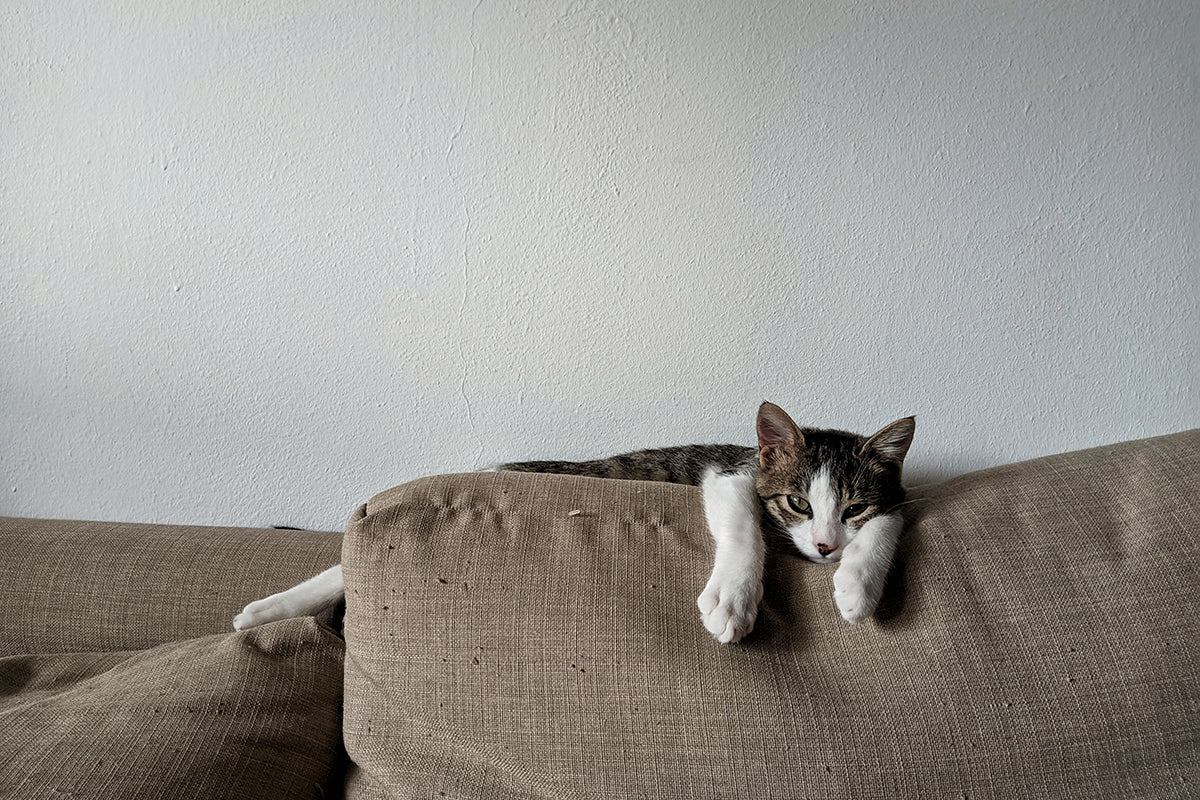
How to Keep Cats Off Furniture
Cats seek warm, high spots, which is why they pick your couch. Give your cat a better perch, like a cat tree or a warm bed, and reward them for using it. Then make the furniture less appealing with a safe deterrent, such as a mat, double-sided tape, or foil. What works varies by cat.

Cats might even scratch your furniture, and that's not even talking about the issue of cat hair. You love sharing your home with your cat, but maybe you don't love what they do to your furniture. What can you do?
Ways to keep cats off furniture
- Give your cat a better perch.
- Reward them for using it.
- Make the furniture less appealing.
- Adjust to your cat.
Why won't my cat stay off the furniture?
"No worries," you think. "I'll just train my cat to stay off the couch." But it isn't always that easy. Methods that might work for other types of training may not keep your cat off furniture. Why? Climbing is a natural part of being a cat, and cats love to seek out high places. The same goes for scratching furniture. You're likely not going to stop the behavior, but you can redirect it. For cats that find their happy place on your sofa, a good first step is to provide a suitable alternative that both you and your cat agree is OK.
Are cats warm-blooded?
Yes. Cats are warm-blooded mammals, or endotherms, which means they make their own heat and keep a steady body temperature, normally about 100.5 to 102.5°F. That's one reason your cat heads for a sunny window, a heater, or your warm couch. A warm, soft spot of their own gives them a better choice.
Method 1: How do I give my cat somewhere better to climb?
Consider redirecting your kitty with a cat tree. Place treats or toys in the cat tree to encourage your cat to hang out there instead of on your couch. Don't have a lot of space? No problem! You can use a cool cat tree with multiple levels that simply hangs on the back of a door, like the K&H Hangin' Feline Funhouse Cat Tree. The cat tree offers a major incentive over your furniture: its height. Cats love high places, and cat trees help them feel safe and secure.
Cats also love windows, so instead of trying to shoo them off the windowsill or the back of a nearby chair for the umpteenth time, lean into this love with a window-mounted kitty sill, like the K&H EZ Mount Kitty Sill Cradle Scratcher or K&H EZ Mount Kitty Sill Scratcher. These help encourage your cat to stay off the furniture and have built-in scratchers to entertain your cat. (Cat TV + scratching. Two things cats love!)
Method 2: How do I reward my cat for using it?
While you may not be able to train your feline to stay off your couch, you can reward them (and train them) when they scratch and hang out on more cat-appropriate items by reinforcing the good behavior with a treat.
Method 3: What deterrents keep cats off furniture?
Try a Deterrent
Even with alternatives, your cat may still try to lounge on the furniture. (You know what they say about old habits.) So how do you keep cats off furniture? In this case, you might want to experiment with a subtle deterrent. The idea is to make the sofa less appealing to your cat so that he begins to avoid it by his own decision. It's a bit of reverse psychology. You're not telling him “no" (which probably won't work anyway); you're helping him change his mind.
One easy way to do this is to use a K&H Pet Deterrent Mat. These lightweight mats are shiny and reflective and make a crinkly noise that most cats don't like. Choose a size and shape that fits the furniture you want to protect, and cover it with the mat. Some cats will find the material annoying and may decide it's not worth the trouble of getting on the furniture. Double-sided tape and crumpled aluminum foil work on the same principle, since many cats dislike a sticky or crinkly surface under their paws. Skip scented sprays made with citrus or essential oils, which are toxic to cats, and never shoo your cat off or use a spray bottle.
By making the furniture undesirable, your cat may be more likely to use his bed and scratcher. Use mats like these as cat couch protectors. You can also use them to protect countertops, plants, and even Christmas trees (a perennial feline favorite). Simply remove the mat when it's no longer needed.
Method 4: What if it still doesn't work?
Keeping cats off the furniture is not a one-size-fits-all solution. It's a matter of doing a bit of research, trying some new ideas, and most importantly, knowing your cat's unique personality. What may work for one cat might not work with another. Experiment, keep trying, and know when to compromise (maybe it's OK if he uses that couch). With a little patience and some experimenting, you can improve the situation.
FAQ about cats and warmth
Are cats warm-blooded?
Yes. Like other mammals, cats are endotherms: their bodies produce their own heat and hold a steady internal temperature no matter how warm or cool the room is. Their love of warmth is why you'll often find them in a sunny window, near a heater, or curled up on the couch.
What is a cat's normal body temperature?
A healthy cat's body temperature averages about 100.5 to 102.5°F, according to PetMD. Cats run warmer than people, so touch alone can't tell you whether your cat's temperature is normal. If a reading falls outside that range, call your vet.